
South High School
|
Greetings South Community: All past issues of this newsletter are available at the following link: TWaS Archive. TW@S is also linked to my Canvas Module for all students and families to access and is shared on South’s FB page. |
|
Part I: Timely Updates & Deadlines: |
|
Attendance Score Board Year To Date |
|
|
Total number of tardies Number of students with 6 or more tardies |
2469 (904 to first period) (+675) since last week 145 |
|
Percent of students with 90% or better attendance |
77.8% |
|
90% attendance rate by class - Juniors have pulled ahead of freshmen for the strongest attendance year to date. |
Freshmen 81% Sophomores 78% Juniors 82% Seniors 68% |
The nurse’s office will begin health screening all new to district students this week. This required screening consists of hearing and vision testing. Students will be called down to the nurse’s office for screening individually, then promptly sent back to class once complete. The whole process should take 5-10 minutes per student. Please call or email Nurse Susie Whited at (907)742-6289, email: whited_susan@asdk12.org with any questions or need for additional information.
September is National Suicide Prevention Awareness Month, a nationally recognized time to raise awareness, spread hope, and encourage meaningful conversations about mental health and suicide prevention. At South, our goal is to make sure students have access to the support, resources, and tools they need to recognize warning signs, support one another, and know when and how to ask for help.
If you or someone you know needs support, please don’t hesitate to reach out to your counselor or another trusted adult, the You Are Not Alone Club, or the CareLine at 988. Help is available.
South Parent-Teacher-Student Organization is looking for volunteers to staff the school store at lunch. If you are interested, please sign up using the following form, and complete the ASD Volunteer Form. Find details at https://sahsptso.com/.
Spring Break 2027: South is going to Scotland and Ireland. There will be an informational meeting in the library on Tuesday, September 8 at 6:00 p.m. Visit the website for details about the trip www.eftours.com/3016878MZ.
|
Part II: Activities Announcements & Results: |
|
Box Scores |
|
|
Volleyball: C: (3-1) wins v. Chugiak, West, Diamond; loss v. Service JV: (3-1) wins v. Service, West, Dimond, loss to Chugiak V: (3-1) last week, with wins v. Chugiak, Service & West. Loss to Dimond. Next games at East on Tuesday and West Spiketacular Friday and Saturday Cross Country Run: At Chugiak Stampede 119 runners. Boys Varsity 2nd amongst 16 teams. Notable results HERE. Swimming: At State Invitational Notable results HERE. *I’m happy to report more results. Please send via email before Monday morning. |
|
Monday, 9/21 |
|
|
|
Tuesday, 9/22 |
|
|
|
Wednesday, 9/23 |
|
|
|
Thursday, 9/24 |
|
|
|
Friday, 9/25 |
|
|
|
Saturday, 9/26 |
|
|
|
Part III: Principal Perspective |
-John Dewey, paraphrased from The Craftsmen, Chapter 8: Resistance and Ambiguity
I suspect the answer to most of these questions lies in our desire to avoid resistance, uncertainty, and the need to slow down long enough to consume and internalize the information. The brain is lazy. So, if we think we can reduce its load by externalizing a process, we tend to do it. The absolute extreme is skipping the act of thinking and creating entirely by allowing a machine (AI) to do it. But that leads to a different kind of overwhelming feeling. And it leads to yet another question:
What happens when we attempt to use someone else's script to accomplish a shared outcome?
It usually feels awkward. This is because each one of us has different life experiences, different background knowledge, and different ways of seeing. So, what looks like a logical thought process on paper to one person can look very different to another person, even though they are attempting to reach the same outcome and solve the same problem. Even if we are well-intentioned and want to make others’ learning process more efficient, sometimes our best intentions actually do harm.
Ultimately, this is where absolute standardization of learning fails. We each need a subtly different path to the same outcome. This can be very difficult with large groups because subtlety demands time and interaction with others trying to solve the same problem. The rate of interaction goes down and the need for efficiency goes up when we have large groups. If the large group does not have shared background knowledge, it is even harder. So, our temptation is to standardize for efficiency even if that doesn’t serve the group’s best interest in getting better at solving non-standard problems.
Efficiency is often synonymous with creating a script or process that is rigid and unresponsive to different perspectives. Imagine learning as an assembly line--that thought experiment should fail. What might work for an inert object like a car does not work for a non-standard organic organism, like a high school student.
To the contrary, in an ideal setting, one person offers their best understanding and ideas, another adds to it, the interaction carries on responding to growing understanding, and in the end, we are all smarter for having faced the problem together. There is no way to standardize the steps in that process other than to acknowledge that a process is necessary to achieve better understanding. After all, the smartest person in the room is the room (Bennis).
This all suggests that we start with the end in mind rather than attempting to follow a rote recipe for learning. As Sennett writes late in Chapter Eight of The Craftsmen:
The necessity of imagination appears in the use of tools. If these tools prove limited or difficult to use, still inventiveness enables a certain kind of repair work, a dynamic repair.... Progress occurs in fits and starts. But people can and do get better. We might wish to simplify and rationalize skills, as teaching manuals often do, but this is not possible because we are complex organisms. (p. 238)
This should be our mantra when we begin thinking about how to design learning processes. Let me translate. Sennett’s tools that “prove limited” are the same as the scripts we often try to create to make learning efficient. Yet, it is the moment at which a tool or script fails that learning starts to occur. This is because tension arises and learning and development require tension and uncertainty. The person completing the task is aware the process has stopped working and the only way forward is to adapt the process and take a different approach. This is where inefficiency has to be tolerated. It is also where we need to teach students to be patient and accept uncertainty.
Three simple, but not easy strategies can be used to address uncertainty:
(Sennett, p. 220-221)
So, while we cannot entirely get rid of process-based documents that attempt to structure learning, we would do much better to start with the end in mind, acknowledge there are certain time-honored techniques for solving problems, yet keep in mind that based on each learner’s background, those techniques might not work best. Or, the learner might not have enough background knowledge and practice in order to understand and use them. This suggests returning to the simplest elements of the process, practicing them over and over, allowing for internalization of basic skills, and then reapproaching the problem.
Of course, this all assumes that we have the patience to stick with the process for a long time. There is no other way of developing background knowledge and the ability to manipulate that knowledge and combine it with other information and tools to solve novel problems. In other words, “Creativity is a byproduct of mastery of the sort that is cultivated through long practice” (Crawford, p. 51, italics mine). What those epic documents and processes attempt to do is demystify accumulation of background knowledge. Yet, we all have such different backgrounds that it would be better to start with the overall method rather than the discreet steps the creator of the document thought would lead to a standard outcome.
The method would be to:
This method gives the learner a degree of ownership and independence that we want our students to develop. If we don’t give them a method, they are likely to stall when they no longer have extensive support structures. High school is the land of endless second chances. So, we can use this method to give our students numerous opportunities to reach common outcomes. Ideally, they get so efficient using it they can translate it to messy problems later.
The opposite approach would be to attempt to get rid of ever possibly facing a hard problem by standardizing a process or just getting rid of the problem altogether. This represents preparing the road for the child rather than the child for the road, which never works. This will never work in the real world where there are no solutions in the back of the book and no algorithm, no matter how advanced, can solve the problem. Our students need methods for what happens when the rules break down or there were no rules in the first place. If we want our learning spaces to truly prepare students for life after school, we need to move away from creating massive documents that try to remove tension and uncertainty from the teaching and learning process, and start injecting some uncertainty as the necessary means to learning patience, reflection, persistence, and independence.
To that end, the table provides a general overview of how we might do that based on the level of uncertainty we introduce to our students.
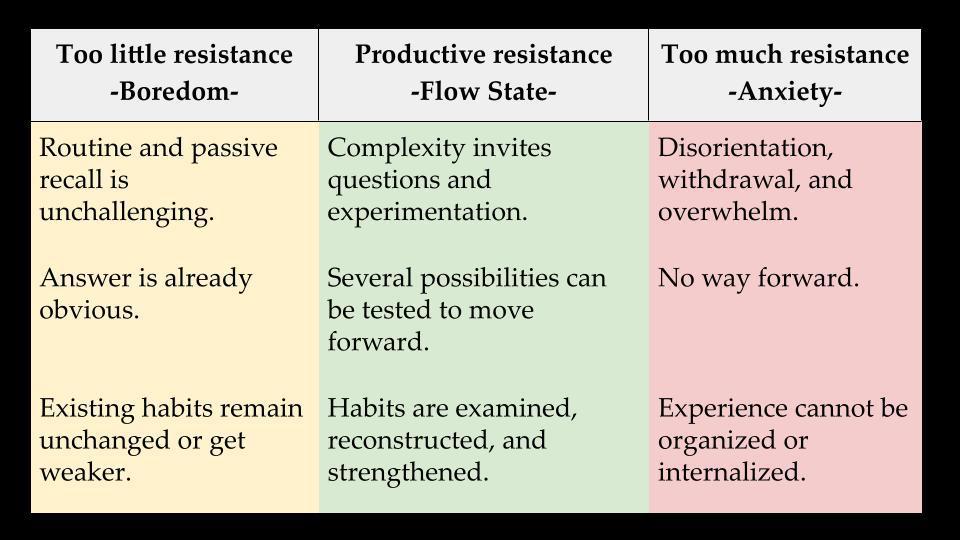
On the low end, a task that does not present enough tension or uncertainty results in boredom and the desire to avoid the task. However, there is danger in this approach. If we allow technology to replace basic skills development, we will create students incapable of thinking because they do not have the raw material to approach any problem. If we remove the opportunity to develop the basic skills needed to solve higher order problems or to adapt knowledge to different domains, then we end up with students on the opposite end of the spectrum, anxiety ridden because they do not know how to proceed. So, the solution lies in moderation. If we give students problems they have a chance of solving, even if it takes the methodical approach outlined above, then we give them the opportunity to be energized by the task and to develop mastery.
Another way of looking at this table is through the enabler-mentor-enforcer mindset (Yeager, 10 to 25). Enablers who do not want students to face difficulty will remove tension from the learning process resulting in bored students who may like the teacher because their life is made easy, but who have no motivation to learn. This is ruinous empathy. On the opposite extreme are enforcers who demand excellence without acknowledgement of the processes and support needed to develop it. The result is often defensive withdrawal.
In the middle is a mentor who works with a student to develop the skills needed to move toward mastery, even if mastery is never attained. This is more like a partnership, neither doing the work for the student nor demanding more than they are capable of producing. This is where patience, progress, and independence are likely to occur. It is also non-standard by default. There is no way to script what a teacher and student do when they are engaged in the process of working together to build knowledge and work toward mastery. We can know the structure of the process, but not the discreet steps and adjustments that will be needed in the midst of the process. We must trust those to the judgement of the teacher and student.
So, we don’t need to create more information and evermore complex documents that attempt to take tension out of learning. We need to invest in the simple, but not easy process of stating outcomes, and then providing the time, interaction, and flexibility needed to attain them.
It is easy to overcomplicate and overwhelm; it is much harder to simplify and focus. Let’s do the harder thing.
Part III is also on Substack: @OnPrincipal
